
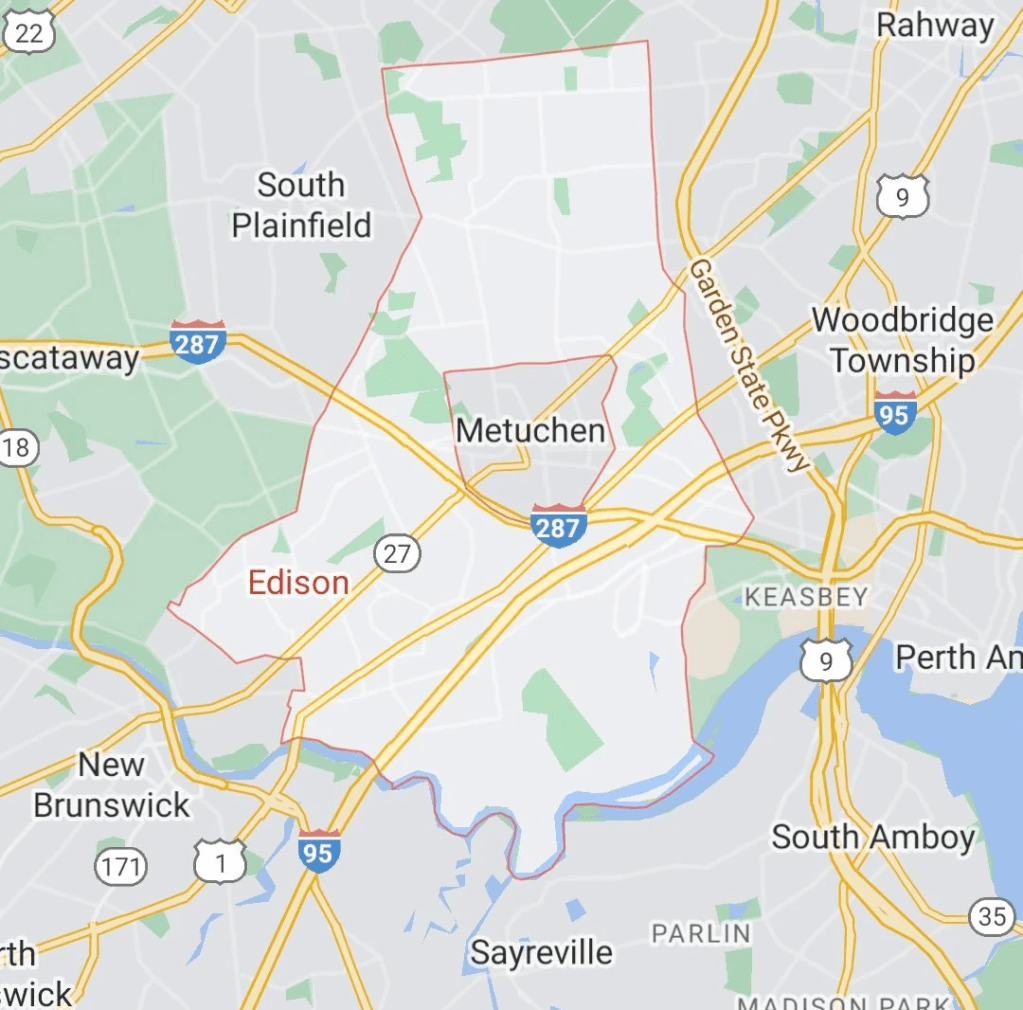
In my town, a surefire way to make everyone mad at you is to suggest that we consider merging with the much larger town that completely surrounds us. But I can’t resist.
New Jersey is a high tax state, and the property taxes in Metuchen are the highest in Middlesex County. Some people are interested only in using this as a political cudgel, but I’m interested in the question of why, and what options are there to bring the costs down? The question of whether merging with Edison, our neighbor on all sides, would bring down our taxes is an obvious question to consider.
I decided to do some digging.
The short answer is that I suspect that it could save Metuchen households up to $2k/year if we merged with Edison, but that Metuchenites value our independence and are ultimately willing to bear the cost for it.
Consolidation: not an automatic win
Town consolidation has been a hot topic in New Jersey for decades. There is a widely held perception that Jersey is fragmented into little tiny municipalities that have no modern reason to exist independently, and that this drives our high municipal costs.
A 2014 study out of Rutgers challenges both of these assumptions. It is worth a read, but two major points stood out to me:
- NJ’s local governments actually serve more people on average than most states. We’re 14th in number of people served per government.

- There is no major difference in cost per capita between small and large towns, once you separate out the resort towns, which are outliers.

The major conclusion here is that consolidation is not an automatic win for government efficiency. It’s not saying that towns shouldn’t merge, but just that each individual case needs to be carefully considered.
Some background
The histories of Metuchen and Edison are closely linked. In 1870, they were both part of the newly created Raritan Township, along with Highland Park, a small, Metuchen-sized borough that sits directly across the Raritan River from downtown New Brunswick.
Metuchen is located at an area that has been a crossroads since colonial times. It became a railroad junction in the 1800s and developed into a proper village. It split from Raritan Township in 1900, followed by Highland Park in 1905. The remainder of Raritan Township renamed itself Edison in 1954, which coincided with its transformation from a bag of hamlets to a consolidated suburb.
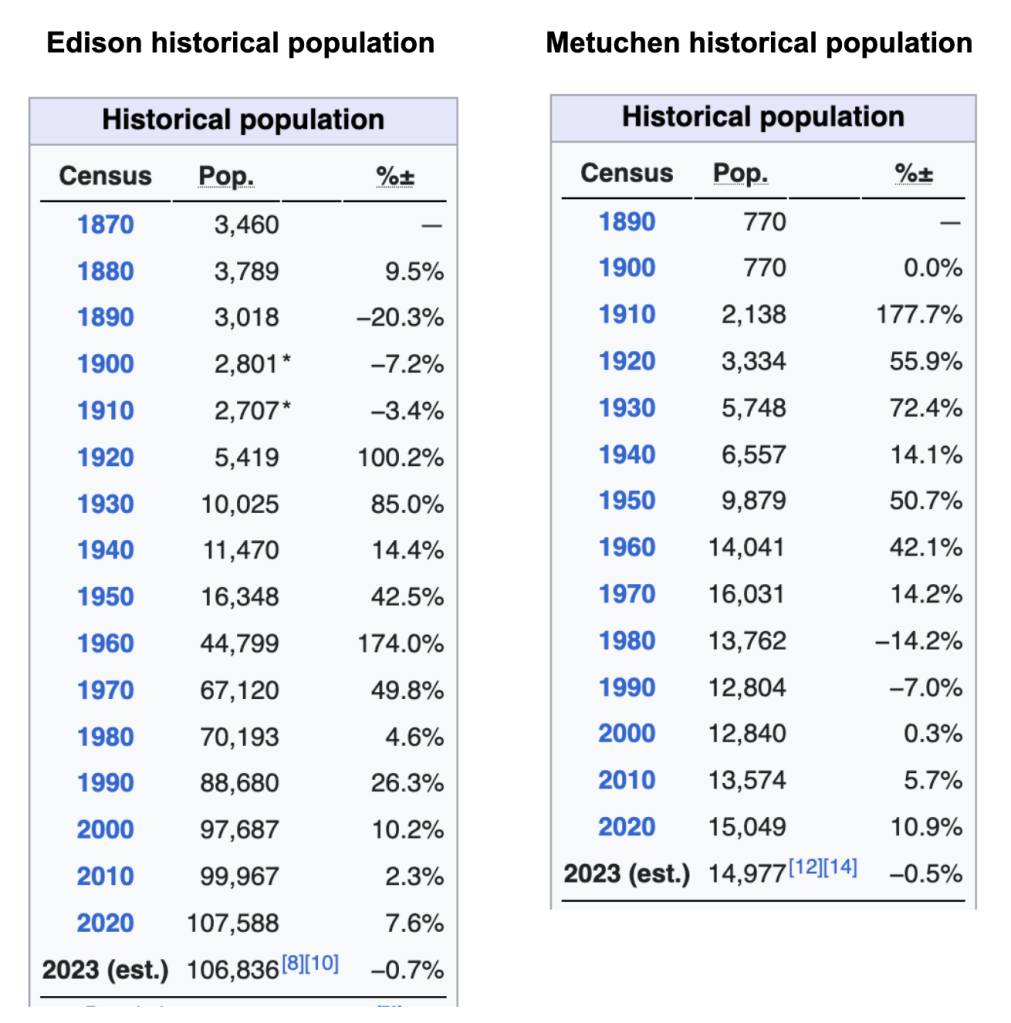
In 1950, Edison had about 16,000 people. It now has over 100,000, and is Jersey’s 6th largest municipality. Metuchen, on the other hand, was already densely populated by the 1950s, growing from just under 10,000 people in 1950 to 15,000 today. Metuchen actually peaked in population in the 1970s, at over 17,000 people. Metuchen remains the more densely populated of the two towns (5,282.2/sq mi vs 3,578.2/sq mi), but I suspect if the commercial and industrial land areas of Edison were excluded, the densities would be similar.
The area has evolved from a rural area with a couple of consolidated villages at Metuchen and Highland Park into a continuous suburban landscape. Aside from distinctive street sign design and welcome signs at the boundaries, there is almost nothing that would indicate to a visitor traveling along NJ-27 from New Brunswick to Woodbridge Township that they have passed through 3 different towns.
It has happened before
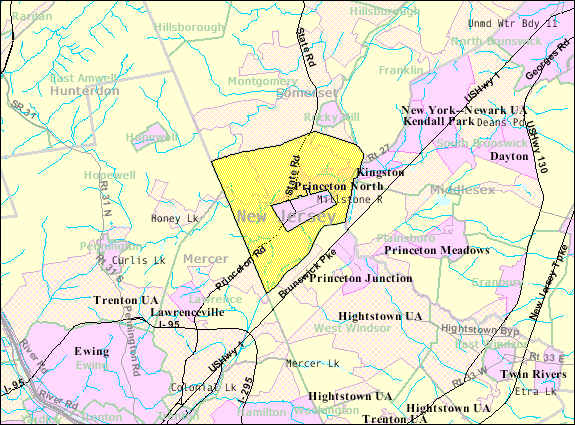
The best comparison to a hypothetical Metuchen-Edison merger is the consolidation of Princeton Borough and Princeton Township. Those towns also had a “donut hole” geography. After many years of proposals and shared services, the two municipalities merged in 2011. While the consolidation is generally considered a success, it was the first major consolidation in decades in New Jersey, and there haven’t been any other major consolidations in the years since.
What about us?
I’m no expert, but I suspect that a merger between Metuchen and Edison would bring down taxes in Metuchen in the long run. The average home value is almost the same between Edison and Metuchen, but Metuchen has taxes that are a couple thousand higher ($12,730 vs. $10,403). Edison has way more economy of scale, being about 7x our size, and a significant commercial and industrial tax base, bringing down the tax burden born by homeowners. It might also not be a bad deal for Edison, because of how close the home values are. Obviously, to get an accurate idea of the property tax impact, a much more thorough analysis of both towns’ finances than this would have to be done. I’m simply pointing out that on the surface, there is a lot of compatibility.
However, there would be significant initial costs. The Princeton municipalities shared services for years before the merger, including a consolidated school district. Edison and Metuchen are run more independently, so there would be significantly more work to do. Also, there were many one-time costs as redundant positions were eliminated. The impact of those job losses on the people affected also has to be acknowledged.
The Rutgers study cites the question of whether consolidation candidate towns already feel like one community as a consideration. I lived in Princeton for grad school in 2006-2008, before the merger. I wasn’t engaged at all with town life outside of the university, but it was my perception that it was mostly a matter of trivia that the Borough and Township were technically independent. Princeton Borough and Princeton Township (as well as parts of other municipalities, like West Windsor) were generally considered part of a “Greater Princeton area”. Metuchen, on the other hand, has a much stronger sense of an independent identity from Edison. That need not be a deal-breaker; nearby Woodbridge Township is an example of a place where hamlets retain very strong identities within a larger municipality, even retaining independent “city” names in their postal addresses. So there precedent for communities to persist in a larger municipality.
Don’t hold your breath
I would be surprised if Metuchen and Edison willingly merge anytime in the near future. I have never heard an Edison resident express an opinion about it, and from what I can see, there is almost no pro-merger constituency in Metuchen today. Metuchenites may grumble about our high property taxes, but all of the evidence indicates that when the chips are down, it is the price we are willing to pay for independence.

 Never Down, Always Up