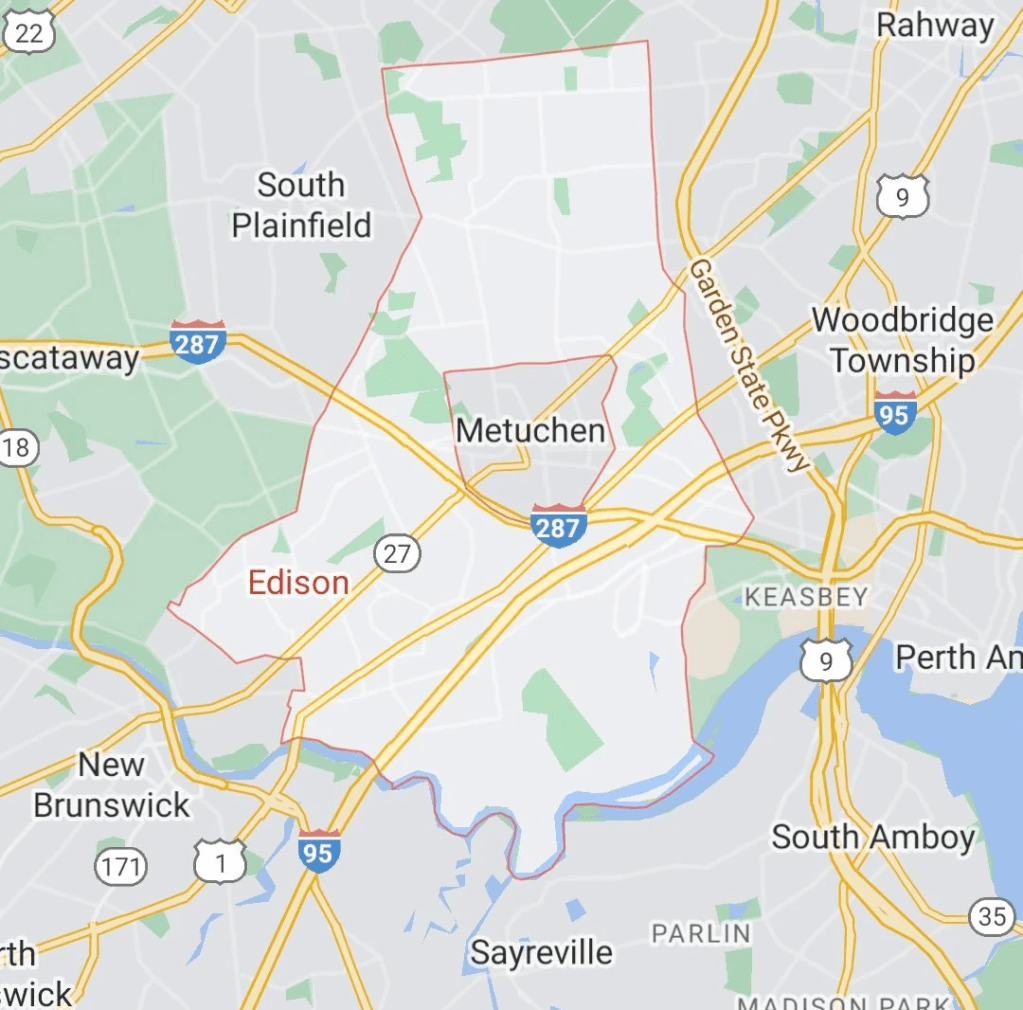
Edtuchen: Should my town merge?

Screenshot of Google Maps centered on Metuchen, NJ, showing how it is completely surrounded by Edison, NJ.

In my town, a surefire way to make everyone mad at you is to suggest that we consider merging with the much larger town that completely surrounds us. But I can’t resist.

New Jersey is a high tax state, and the property taxes in Metuchen are the highest in Middlesex County. Some people are interested only in using this as a political cudgel, but I’m interested in the question of why, and what options are there to bring the costs down? The question of whether merging with Edison, our neighbor on all sides, would bring down our taxes is an obvious question to consider.

I decided to do some digging.

Continue reading “Edtuchen: Should my town merge?”

LLMs think

An “AI brain”, rendered by ChatGPT

It’s interesting to see scientific people categorically reject the notion that LLMs “think”. People write them off as “fancy autocomplete” or regurgitating their source material, and conclude that they do something categorically different than what humans can do. That it’s all just a parlor trick. I think1 that’s wrong.

Continue reading “LLMs think”

Intersectionality is nonlinearity

ChatGPT’s rendition of the concept of nonlinearity

My sister, who is a Ph.D. sociologist, first introduced me to the sociological concept of intersectionality. Like many academic sociological terms, it is often misunderstood and misrepresented in popular discourse. But I found a simple way to approach it by thinking about it with my math brain1. I think I can explain it in way that is easy to understand, however you might feel about math.

Continue reading “Intersectionality is nonlinearity”

The AI Big Bang

Image generated from stable diffusion from the prompt: big bang happening in someone's brain

I generated this image with the prompt “big bang happening in someone’s brain” using Stable Diffusion

2022 has been an astounding year in AI. I don’t think anyone needs a recap (and I’m not the guy to provide one), so I’ll namedrop Stable Diffusion and GPT as examples of what I’m talking about.

While only the most jaded person could see what’s going on in AI and not be completely blown away, there is debate around exactly what the socioeconomic implications of this new phase of AI will be. On one hand, you have people already predicting that we’re in the end game for white collar workers, such as artists, writers, and software developers. Other folks, perhaps more attuned to the limitations of the AIs we’ve seen, are urging a much more sober outlook. I see massive change on the horizon, but along a different axis than some of the more simplistic predictions.

Continue reading “The AI Big Bang”

Ableism: the sneakiest “ism”

Fighting the prejudice within myself is a lifelong battle. One of the -isms I struggle most with is ableism. It comes through in my language, and as I’ll explain, I believe it underlies a stubborn prejudice in my heart. It is completely normalized to demean things and people as “stupid” or “crazy”. If you want to know why this is a bad thing, this article does a good job of explaining. Please read it, and do try to suspend the voice in your head that thinks it’s maybe being a bit excessive. Just for a minute.

All done? Great, because instead of stating the point they’ve made so well, I want to talk about why I accept it.

Continue reading “Ableism: the sneakiest “ism””

A bitter pill

Several years ago, I returned to Baltimore for the funeral of one of the kids I coached in basketball. He was stabbed to death in an altercation at a gas station. I almost wrote a piece about my feelings, but never did.

Last week, I learned that a student I taught was found shot to death on the street. I don’t know anything more about what happened. There’s no news story about it. If you know the intro to the track Straight Outta Compton…well, almost 30 years later, not much has changed.

This kid was one of the kids who defined my experience as a teacher. He was funny as hell, complex, brilliant, stubborn, inquisitive, and energetic. In one particularly out-of-control class period, he got carried away and was standing on his desk ring-leading the chaos. Floundering to figure out how to regain some semblance of control, I play-lunged at him, and he quickly scrambled back down, saying something probably like “Mr. Johnson ain’t playing”. I earned a little cred, the wrong way. (Not my proudest moment as a teacher, but I never claimed to have been great at the job.)

He and I didn’t always get along, but we also had moments of the two years I taught him where I think I really reached him. On my last day with the students, I let them write reflections about their time with me, if they wanted to. Each one was almost shockingly introspective and grateful for what I had at least tried to accomplish. But this kid’s was hands-down the most heartfelt. That day may have been the last time I saw him, and I’m presuming our lives diverged significantly from that point.

Sadly, I wasn’t able to get enough information to make it back to pay my respects and just express my support to his family and any of his classmates that would have come. But it’s also a reminder of how marginal I am in that world, where media, justice, economics, and just about everything else are entirely different than in the bourgeois world I inhabit. Premature death is so common in Baltimore that young people talk about how they want to be memorialized on a t-shirt in the same way that I might think about a living will.

When I returned to Baltimore for that last funeral, it hit me in the gut that, in a sense that is almost too literal for comfort, I helicopter in and out out of that world at will. But my former students, that precarious world is their default, and they venture out only with incredible difficulty, as the forces of concentrated poverty constantly pull them back in. The people who stay in teaching in places like Baltimore choose to be permanent residents of that world, and a bridge to other worlds. I’m forever in awe of those who stay in the career.

America, the pitiful

I don’t know enough about immigration to say whether this sort of thing is meaningfully different from previous administrations. But one thing’s for sure, our current administration exudes a hostility to foreigners that is unprecedented, and that perception matters quite a bit.
 
When I read about this and:
 
 
I have to think that if things don’t change, we’re witnessing the self-inflicted end of America’s role as the nucleus of human culture and knowledge.
 
We’re not becoming great again. We’re decaying.


Public Enemy #1

Capone Chase, who I taught for a year and a half, has been declared Baltimore’s Public Enemy #1. He is wanted for allegedly murdering another young man execution-style on a playground within a couple days of having been released from jail for another crime.

The Capone I taught was a difficult kid, but to imagine him executing a person on a playground is chilling to say the least.

Capone was one of the brightest students I taught, not really in performance, but in raw ability to master new concepts quickly. He attended class only sporadically, yet he passed the High School Assessment for Algebra on his first shot, and by a pretty good margin, as I recall. That’s something a large majority of my students failed to do on their first try, and he did it after transferring to my school mid-year from Patterson, one of the worst schools in the city (where, incidentally, my girlfriend also taught him), and barely doing his classwork.

Capone often came to school visibly seething from something that was under his skin. He had serious issues with authority and handling conflict. He often viewed situations in black and white. He seemed to walk around with a serious victim complex, as though the entire world was constantly trying to oppress him. If he felt like he was singled out, he had a tendency to flip out. I tried hard to teach him that not everybody was out to get him, and that if he let things that annoyed him slide, he’s spend far less time caught up in conflict. But he had a serious tendency to escalate things out of proportion.

That being said, he rarely was disrespectful to me as a teacher. In most cases, he was polite and articulate. The main exceptions were when I needed him to do something he didn’t feel like doing, which would often send him to victim mode, and a tirade of “f’ this, f’ that, why you always picking on me?” Once in that mode, it would typically be very difficult to get him back on an even keel. Over time, he and his best friend at FAST realized they were probably among the “hardest” at the school, and by mid sophomore year, they were too cool to attend much class at all. He quit the basketball team mid-season, after a falling out with Coach Peyton, and after that, he kind of entered a downward spiral of caring less and less about school. I don’t know if I saw him at all in the final quarter of sophomore year.

To me, Capone is a poster child for the type of kid who would likely be on a completely different life path had he been raised in normal, non-toxic environment. He clearly came in the door with some deep baggage on a daily basis. Like most of the kids I taught, it was difficult to conceptualize what his out-of-school life must have been like. But I saw it wear him down over time. Poverty almost seems too quaint a word for years of corrosive home life.

It’s easy to imagine an alternate universe where Capone excelled in high school and would be enjoying the summer off between first in second years in college. Not on the run from the law, having allegedly shot a man in the head. In a playground.


End of the journey

This past Saturday, I traveled back to Baltimore for the moment I poured my blood, sweat, and tears to see: the graduation of the first class of Friendship Academy of Science and Technology, better known as FAST.  Being that my students are no longer students, it’s probably safe at last for me to explicitly identify the school where I worked (as if it were ever a big secret).  Given how hard I worked with this day in mind, to have it finally arrive is, hands-down, the proudest moment of my life.  My hat is off completely to my coworkers who worked much longer and harder than I did for this day to come, to all career teachers out there who educate far more young people than I did, and to Errol Duncan, who didn’t get the chance to see his work come to fruition.

We fought some truly epic battles as a staff to try to establish a culture of scholarship and success.  I can’t even describe how hard we worked to get keep our students in uniform, to march them down the hall in quiet, straight lines, to stamp out profanity, to require respectful behavior toward peers and staff, to demand punctuality, to enlist parent support.  We spent countless hours meeting together to strategize how to work with individual students and how to build effective systems.  And that’s not even mentioning academic instruction, let alone the High School Assessment tests the students had to pass to graduate.

By the numbers: from an early roster of mine, it looks like at one point, the original FAST 9th grade class numbered 95 students. The graduation program listed 59 graduating seniors.  Among those were about 48 students I taught, and 36 of those were students on that early roster, whom I taught for two years, some as early as Summer Bridge.  Seven came from my infamous homeroom, Class 901, whom I saw for almost 4 hours a day, every other day, my first year teaching.  Looking at those early rosters, I feel a mix of emotions.  On one hand, for those 7 kids that managed to make it to graduation from my homeroom, I feel nothing but respect.  I know I wasn’t the greatest teacher in the world, and yet, they managed to persevere through my ineptness and abysmal behavior from some of their peers.  Of the whole group of seniors, it looks like a lot are college-bound, a handful with some serious scholarship money.

On the other hand, a lot of names I had high hopes for weren’t in the graduation program.  By my recollection, only one of maybe a dozen English-language learners that I taught made it through.  Many of those kids were the sweetest, most resilient, most respectful children I had the opportunity to interact with.  They had come to America as refugees or immigrants, only to be plunked down into Baltimore City Public Schools.  It’s unpleasantly surprising, because I felt like FAST did a really good job of providing for them.  To be fair, many of them transferred away or moved and may have gone on to graduate somewhere else.  But I know for a fact that two of my most promising immigrant students became pregnant and dropped out.

All things considered, I’m still extremely proud of what my students accomplished, navigating the minefield of adolescence in Baltimore to finish their high school educations.  I never thought graduation day was going to be completely perfect.  How could it be, given the challenges?

June 17, 2008.  That is the date of the first post in this journal, and the beginning of my journey as a teacher, which paralleled that of my students.  From one of my first posts:

The biggest things I plan to internalize are to establish relationships with the students, the other teachers, the administrators, the corps members, and the community, to not succumb to negativity and defeatism, to never waver in setting high expectations for the kids, to be respectful and humble, and to be prepared to work relentlessly.  I’ve got a lot of learning to do these next couple of months.

And this much has been impressed upon me more than anything:  the experience of teaching in inner city Baltimore is going to be extremely tough.  I’d say all of us are somewhat scared to death, and we’d be fools not to be.  But we’re also fired up, and even after a just a couple of days, we’re already starting to band together and dig in.

Wow.  Overwhelmed as I was, that’s actually pretty much spot on.  If nothing else, I did a good job of absorbing the most salient points, because those are things I really did try to keep in mind throughout, even if I wasn’t always successful.  In some sense, it’s hard to believe that four years have passed.  But I’m extremely thankful today that I kept this journal to go back through to relive the experience, and remember what it was like to not know all the things I’d come to learn.  Hopefully there are lessons in here for some future teacher to learn from.  To be fair, there wasn’t much of my blood involved in the experience, but I think the copious sweat and tears more than made up for it.

Even though I intend to maintain a lifelong engagement with education, I think it’s finally time to close the book on my education journal.  I may continue to add new entries to this journal when something education-related catches my eye, but there likely won’t be much else.  Looking back, teaching is by far the most difficult thing I’ve ever done in my life.  As this journal can attest to, I barely made it through two years.  I am absolutely awed by anybody who makes a career of teaching or school administration.  What I do as an computer/electrical engineer is supposed to be “hard”, but it doesn’t even chart in comparison.

Don’t be surprised if there’s a Volume Two sometime in the future.  Despite a recurring dream (okay, slight nightmare) where I’m sucked back into school as a last-minute permanent sub, I don’t see myself ever actually teaching high school again.   But I definitely plan to coach again.  And maybe, just maybe, I might find myself in higher ed, education policy, or school leadership when I’m done with the corporate world.  It’s certainly not on my 5-year plan, but never say never, right?